


Low-Voltage Outdoor Lighting
Selected models use DC 12V, DC 24V or DC 12–24V low-voltage designs for garden, pathway and landscape lighting layouts.

Outdoor Illumination for Walkways and Landscapes
Low-voltage fixtures for pathways, gardens, driveways, and yards, with landscape spotlights, inground lights, warm white, and RGBWW options.
Filters
7 products


Upgrade dark, uneven spaces with clean recessed lighting. Enjoy brighter, more balanced illumination and a modern, streamlined ceiling look.

Before

After
Explore real customer questions, application ideas and answers from our team.
A first landscape-lighting project with one complete kit
Answered by LightingWillChoose the fixture by what you want to illuminate

A few things worth checking before you start digging
No discussions in this category yet.
This was my first time doing low-voltage landscape lighting, so I didn’t really want to buy the transformer, wire and fixtures separately and then find out I forgot something.
I used the complete kit along the front walkway and aimed two of the lights at the smaller trees near the porch.
The part I liked most was being able to move the lights around before committing to the final positions. I probably changed the spacing three or four times after seeing everything at night.
I keep the lighting fairly dim most evenings. I’m not trying to light the whole front yard — just enough to make the path easier to see and give the landscaping some depth.
The photocell and timer also mean I’m not thinking about switching them on every evening.
Thanks for sharing the project.
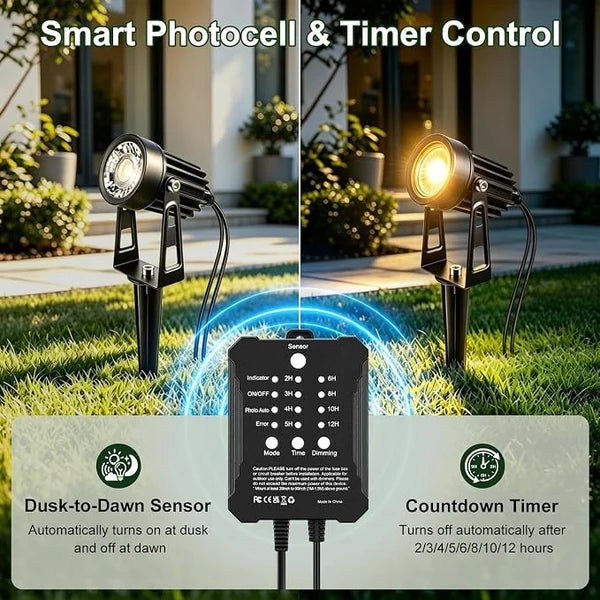
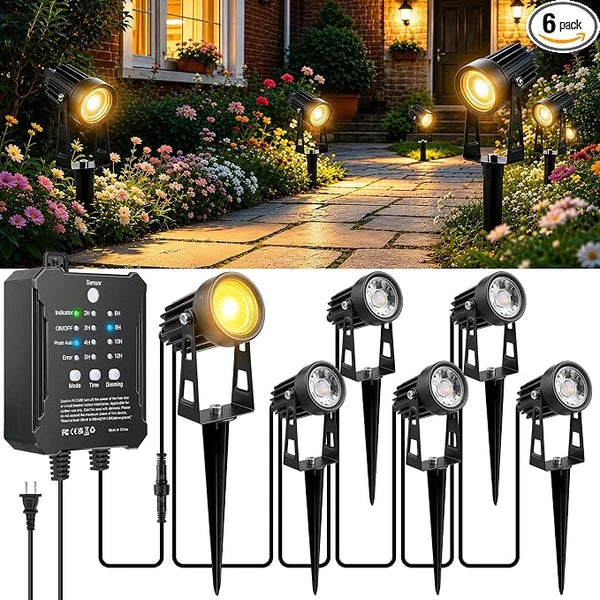
The current All-in-One kit includes 6 or 8 × 3W warm-white spotlights, a smart low-voltage transformer, extension wiring, stakes, mounting hardware and connectors. The transformer includes a photocell, timer settings and 10%–100% dimming, while each spotlight has a 270° adjustable head.
Path and garden lighting works best when the fixture style matches the job.
A light used to illuminate a tree does not need to be mounted the same way as one installed beside a driveway or flush with a deck.
For most projects, the current collection can be separated into three main fixture styles.
Adjustable landscape spotlights
Best when you need to aim the beam at trees, walls, shrubs or architectural details. The current 5W model has a 270° adjustable head, 90° beam and can be installed with either a ground spike or round mounting base.
Recessed inground spotlights
Better when you want the fixture to sit flush with wood, stone or concrete. The current 3W version is IP67 rated, produces warm-white light and uses a recessed walk-over-friendly design.
Inground well lights
Useful for subtle uplighting from ground level. The current warm-white range is available in 1W, 3W and 5W, with 2-, 4- and 10-pack options.
A common mistake with landscape lighting is deciding exactly where every fixture will go before planning how the system will actually be powered.
A better approach is to sketch out the lights, cable paths and transformer location together.
Before installation, check:
1. Fixture voltage
The collection contains DC12V fixtures as well as models compatible with 12V–24V systems. Always build the complete system around compatible voltage requirements.
2. Total wattage
Add the wattage of all connected fixtures before choosing the power supply or transformer.
3. Cable distance
Longer cable runs can introduce voltage drop. LightingWill specifically recommends checking voltage and cable length when using inground fixtures over longer distances.
4. Final nighttime position
Temporarily position adjustable lights and look at the yard after dark before permanently fixing the locations.
5. Outdoor connections
Protect and seal wiring connections from moisture even when the fixtures themselves carry an outdoor waterproof rating.

Fresh Designs. Seamless Lighting.
Meet our latest LED aluminum channel additions, designed to bring a clean, modern finish to your lighting projects.
DISCOVER NOW
Great lighting, special pricing.
Discover this period's featured lighting offers.
Check the applicable products and promotion details before ordering.


